
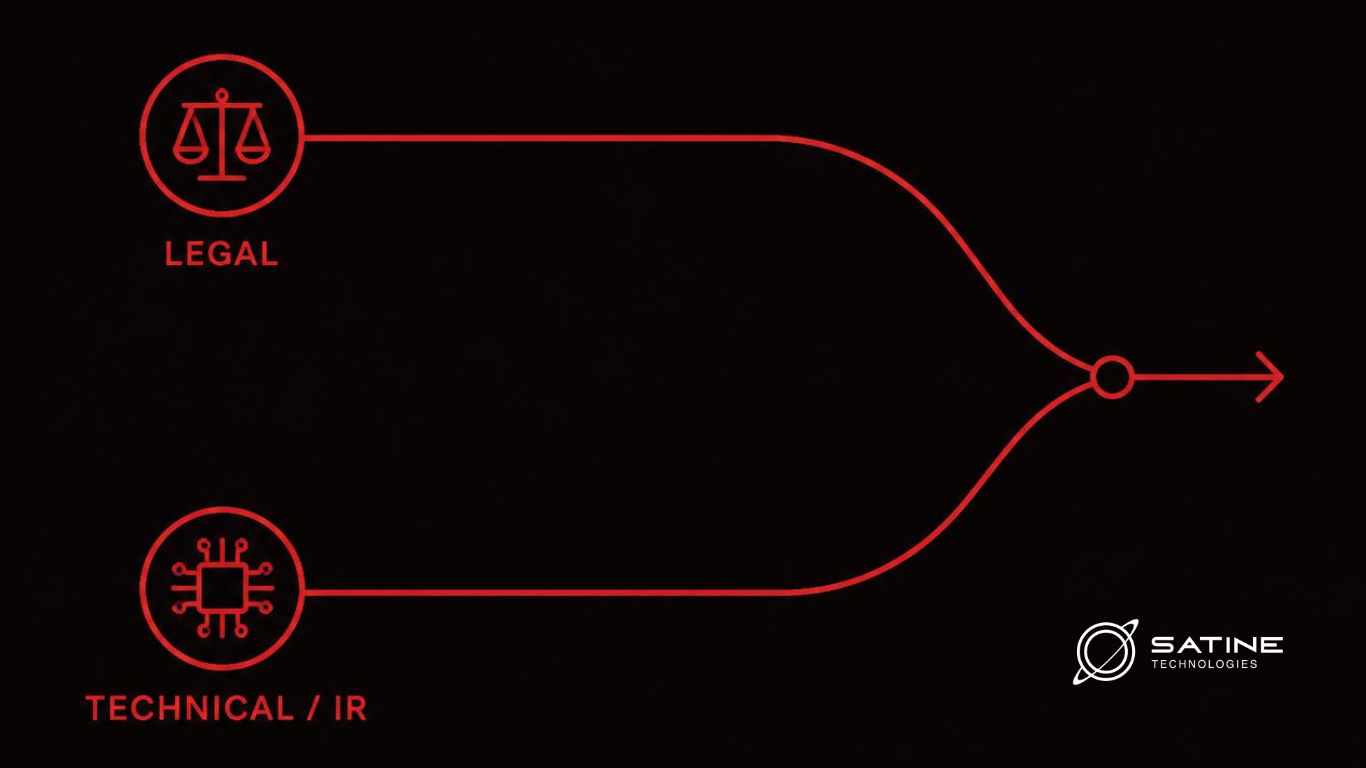
TLDR: Most organizations bring outside counsel into an incident after the technical response has already started, usually once someone asks whether the company is exposed. By then, some of the protections counsel is there to provide are harder to establish and some of the clock has already run. Attorney-client privilege, evidence handling, and regulatory notification timelines all work better when counsel has a standing role before an incident, not a reactive one during it. This post walks through what breaks when counsel joins late, why offensive security work makes that gap more visible, and what proactive legal integration actually looks like.
The Sequence Most Organizations Default to
An incident gets detected. Someone escalates it. Within a few hours, an internal team or an outside IR firm is pulling logs, isolating systems, and trying to understand scope. Somewhere in that process, usually once the situation looks serious enough, someone asks whether legal needs to be involved.
That instinct is not unreasonable on its face. Legal counsel is not operational. Nobody wants a lawyer slowing down containment while a threat actor still has access. So the technical response runs first, and counsel gets looped in once there is something worth calling counsel about.
The problem is that this sequencing treats legal involvement as a decision to be made during the incident, rather than a structure that should already exist when the incident starts.
What Breaks When Counsel Joins Late
Privilege is harder to establish after the fact. Attorney-client privilege and work product protections over forensic findings are strongest when the investigation is structured, from its first hour, as work performed at counsel’s direction for the purpose of providing legal advice. Retrofitting that structure onto an investigation that has already been running for a day or two is possible, but it is a much weaker position than building it in from the start.
Early communications may not be protected. The Slack messages, internal emails, and informal incident timelines that get generated before counsel is involved were not created under privilege. If the incident results in litigation or a regulatory inquiry later, those early communications can become discoverable in a way that later, counsel-directed communications are not.
Regulatory notification clocks do not wait. Breach notification requirements vary by state and by sector, and many of them start running from the moment an organization has enough information to determine that a notification obligation may exist. Determining what counts as “enough information” is itself a legal judgment. An organization without counsel in the room early is often making that determination without the person best positioned to make it.
None of this means the technical response should pause and wait for a lawyer to show up. It means the legal and technical tracks need to be running together from the start, not one after the other.
Why This Shows Up So Clearly in Offensive Security Work
From an offensive security perspective, the gap is easy to see because incidents move faster than most organizations’ internal decision processes. In the first 24 to 48 hours, technical responders are making calls about what to isolate, what to preserve, and what to communicate internally, and those calls carry legal weight whether or not a lawyer is in the room to weigh in.
A responder deciding to take a system offline is also making a decision about evidence preservation. A responder drafting an internal status update is also creating a document that may need to be produced later. These are not separate technical and legal problems. They are the same decision, viewed from two disciplines that are usually not talking to each other yet.
The organizations that handle this well are not the ones with the most sophisticated tooling. They are the ones where the technical team and outside counsel have already worked through these tradeoffs before there was pressure attached to them.
This also shows up in something more subtle: the pace of internal communication during a live incident. Status updates get written quickly, often by whoever is closest to the technical work, because the rest of the organization wants information fast. Those updates tend to include speculation, early theories about root cause, and language that sounds more definitive than the evidence actually supports at that point. Written without legal input, that speculation can end up shaping how the incident is later characterized, even after the technical picture becomes clearer. Counsel involved from the start is not there to slow down communication. Counsel involved from the start helps set the norms for how that communication gets written before the first update goes out.
What Proactive Counsel Integration Looks Like
Getting counsel involved early is not about adding another name to a contact list inside the incident response plan. It is a structural relationship that exists before anything goes wrong.
- Counsel reviews and contributes to the IR plan itself. Not as a formality, but with actual input on how evidence will be handled, when notification determinations get triggered, and who is authorized to speak externally during an incident.
- Counsel participates in tabletop exercises. The first time outside counsel thinks through a ransomware scenario or a data exposure scenario should not be during a live one. Tabletops surface the legal questions and the technical questions in the same room, with time to actually think them through.
- A retainer or engagement structure exists in advance. When counsel has a pre-established relationship with the forensic and IR vendor, the engagement letter that structures privilege over the investigation can be signed and in effect before the first log is pulled, not drafted while the investigation is already underway. This also means counsel and the technical team already know how to reach each other, rather than exchanging introductions in the first hour of a live incident.
- Roles are defined before anyone needs them. Who declares an incident. Who decides when counsel gets looped in. Who has authority to engage an outside forensic firm. If these questions get answered for the first time during an incident, the answers tend to be slower and less consistent than they would be if they were settled in advance.
None of this is complicated to set up. It mostly requires deciding, before there is a crisis, that legal and technical response are one function rather than two functions that talk to each other after the fact.
Actionable Takeaways
A few things worth checking this quarter, independent of whether an incident is anywhere on the horizon:
- Pull up your current IR plan and check whether outside counsel has actually reviewed it, not just been listed as a contact within it.
- Confirm whether a retainer or engagement letter with your forensic and IR vendor already exists, structured through counsel, so it does not need to be drafted for the first time mid-incident.
- Ask your general counsel or outside counsel whether they have participated in a tabletop exercise with your technical team. If the answer is no, that is a gap worth closing before it gets tested for real.
- Clarify who makes the call on regulatory notification determinations, and confirm that person has the legal grounding to make it under time pressure.
- Review who is authorized to communicate externally during an incident, and make sure that authorization was set with legal input, not decided in the moment.
None of these require a new vendor relationship or a large budget line. They require treating legal integration as infrastructure that exists before an incident, the same way an IR retainer or a backup strategy exists before it is needed.
Organizations that build this structure in advance are not eliminating the pressure of a real incident. They are removing one entire category of decision, the legal one, from the list of things being figured out for the first time while the clock is running.